
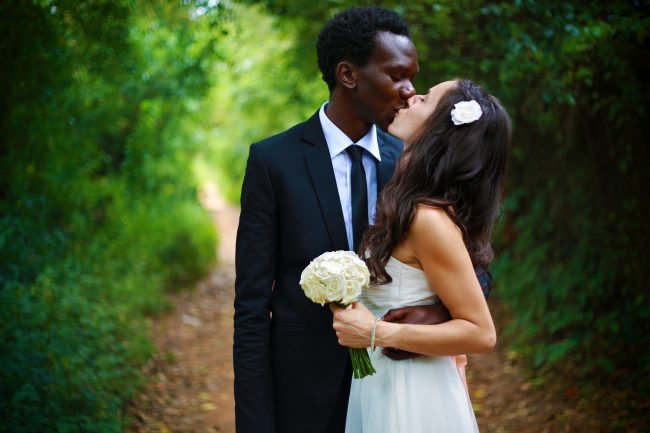
 When you say, “I do” and enter into the covenant of marriage, DO YOU REALLY? Do you really mean what you’re promising? Or are you just mouthing words that sound romantic and seem to fit for that moment in time during the wedding ceremony (and then you don’t mean them later when they don’t seem to “fit” any longer)?
One pastor we heard of, recommends to everyone he marries that they write out their wedding vows, frame them, and then display them somewhere in their home so they’ll continually be reminded what they promised each other. What an outstanding idea! Too often we forget what we promise each other on our wedding day —kind of like the man “who looks at his face in a mirror and after looking at himself, goes away and immediately forgets” (James 1:23-24). We often say our “I do’s” at the altar and then walk away afterward from what we promised as if we never said them.
But we need to tell you that the marriage vows you promise each other, are very important to God. They aren’t something God takes lightly or later forgets. And neither should you or your spouse. The Bible says, “Let your ‘yes’ be yes, and your ‘no’ be no or you will be condemned“ (James 5:12). It’s also noted, “It is a trap for a man to dedicate something rashly and only later consider his vows“ (Proverbs 20:25).
Up front, we want you to know this isn’t a Marriage Message intended to throw verbal stones at anyone. God knows we’re ALL sinners, and no one can “cast the first stone” without throwing some their own way (and Steve and I recognize that we’re included in that mob). Sadly, we’ve sure gone through times when we didn’t take our vows as seriously as we should have!
Instead, this message is hopefully a wake-up call for us all, as it concerns our marriages. As God’s children, we are God’s ambassadors representing the bride and Bridegroom to a world that needs to see this living picture lived out in healthy ways. And may we do so to the glory of God!
Author H. Dale Burke says something important about the marriage vows couples promise each other on their wedding day. He says that those who marry often look at them as a romantic, “legal” or “religious” formality “to be dispensed with before the party can begin” (and afterward they wake up to reality, rather than a lifelong party). He says,
“… Maybe they just consider [their vows] to be a part of cultural tradition, like singing the national anthem before a ball game or saying the pledge of allegiance at the start of a school day. But what SHOULD it mean —what DOES it mean to say such things to a person in the presence of God? What does God do during the wedding? Is He, like us, merely a spectator?”
No. God said, through the Bible, something that both men and women should pay attention to:
“You flood the Lord’s altar with tears. You weep and wail because He no longer pays attention to your offerings or accepts them with pleasure from your hands. You ask, ‘Why?’ It is because the Lord is acting as the witness between you and the wife of your youth, because you have broken faith with her, though she is your partner, the wife of your marriage covenant. Has not the Lord made them one? In flesh and spirit they are His. And why one? Because He was seeking godly offspring. So guard yourself in your spirit, and do not break faith with the wife of your youth. ‘I hate divorce,’ says the Lord God of Israel, ‘and I hate a man’s covering himself [which actually means ‘his wife’] with violence as well as with his garment,’ says the Lord Almighty. So guard yourself in your spirit and do not break faith“ (Malachi 2:13-16).
God takes marriage and committing violence with words and deeds very seriously. It is a way of breaking faith. (Ephesians 4 and 5 and 1 Peter 3 speaks more on this and the way we should conduct ourselves in our marriages so that we live with each other in an “understanding way.”
In all honesty, Steve and I have to admit that we didn’t have much of a grasp on understanding what we were committing ourselves to on our wedding day. If God hadn’t woken us up (and we hadn’t followed His leading), our marriage would have probably ended up as a divorce statistic instead of a love story written by God (which we believe our marriage is now). God showed us that when we started treating each other disrespectfully, our relationship started to go down the same slippery slope that many others go down to their marital deaths (as ours almost did as well).
We had to make a complete reversal of the way we were treating each other and learn how to relate together in healthier ways. And it sure hasn’t been easy, and at times it still isn’t to this day! Even though we know better, we find that we can still fall into the same “disrespectful and unloving” trap other couples do as they try to live out their wedding vows.
When that happens, we have to step back, regroup, connect again with God and with each other, and “fight the good fight” WITH GOD, instead of aiming at and fighting against each other. (If you find yourself in this same hurtful cycle, you’ll find a lot of helpful articles, tools, and recommended resources on the Marriage Missions web site to help you make your relationship a healthier one. Plus, at the end of this article we have a link to an additional article on this subject to help you further.)
H. Dale Burke, in his book, “Different by Design” (published by Moody Press) gives insight on this when he wrote,
“I’ll never forget the couple who showed up in my office weekly trying to patch up their marriage which, while in trouble, had incurred no damage that was beyond repair. … This was just two Christians who hadn’t learned to think ‘we’ instead of ‘me.’ They had never been taught to value and respect one another or nurture their love.
“Tragically, the biggest obstacle standing between them and reconciliation was Christian friends who kept fueling their frustrations and counseling them to give up. The very group of people who should have been cheering their efforts to save the marriage was sabotaging the rescue mission.
“At least one part of this couple’s problem was rooted in a misunderstanding of what marriage is all about. They, like most newlyweds today, saw marriage as a contract, which, according to my dictionary, is a ‘binding agreement.’ At the heart of every contract is a set of conditions or promises —the ‘deal.’ The deal is, you do this for me and I’ll do that for you.
“A contract lays out what ‘this’ and ‘that’ consists of. It also has an escape clause; either stated or implied, which says that if you fail to do ‘this,’ then I can stop doing ‘that.’ And in recent times, quite frankly, many people don’t feel that their contracts mean much of anything. All I need to justify breaking one is to say I’m not happy with the deal.
“Tragically, this flexible concept of contracts is how many people now view marriage. ‘If my marriage is an ordeal,’ they say, ”I’ll opt out and look for a better deal somewhere else.’ This is the unspoken amendment many people attach to their spoken vows of matrimony. Men and women differ in a lot of ways when it comes to what they bring to the marriage relationship, but this is a weakness they both share. Thousands of husbands and wives exercise this escape clause every year.
“A question worth asking, then, if words have meaning and we desire to be responsible with our wedding vows, is the same question abbreviated on so many bracelets and other items in recent years: What would Jesus do? Or better yet, what would Jesus declare about marriage, divorce, and the meaning behind those vows so often heard at weddings?”
You can read what Jesus said in Matthew 19 and you can understand more as you read through what the Bible says about relationships. Saying “I do” is the easy part, living it is a whole different matter. That’s the difficult part!
Through it all, please know that:
“Marriage can be wonderful. It can be deeply satisfying and mutually fulfilling. But IF it becomes that, it is because BOTH partners have paid a very high price over many years to make it that way. They will have died to selfishness a thousand times. They will have had countless difficult conversations. They will have endured sleepless nights and strained days. The will have prayed hundreds of prayers for wisdom and courage and understanding. They will have said, ‘I’m sorry’ too many times to remember. They will have been stretched to the breaking point often enough to have learned that, unless Christ is at the center of both their lives, the odds for achieving marital satisfaction are very, very low” (Bill and Lynne Hybels).
And to that we say, Amen! It’s a tough mission —one that is more difficult than we could ever anticipate before we say “I do.” But with mind-sets to persevere, with intentionality to do what it takes to make your marriage the best it can be, and with God’s help, all things are possible (and can have it’s times of being “wonderful”).
We pray as you look to the Lord, He will help your marriage to be one that reflects the heart of Christ,
Cindy and Steve Wright
-ALSO-
To help you further on this subject, please click onto the link provided below to read the Crosswalk.com article titled:
• 9 SUCCESS FACTORS AFTER SAYING “I DO”






Filed under: Marriage Messages
(KENYA) We are living in a culture where “come-we-stay” type of marriages are very common – where a man stays with a woman without having a wedding and saying their vows. This is very common here. I am in such a situation and I hate it. I believe all the problems we are having are rooted to this. We have been living together for about a decade now and efforts to have my husband solemnise our marriage and say our vows before God and other witnesses in church are fruitless – I feel very insecure.
He is actually more spiritual than I am – an ardent Bible reader and is very prayerful – which I really like. However when I tell him how I feel about our situation he says there is nowhere in the Bible that talks of saying vows and all, and says he doesn’t have the finances to do a wedding anyway. He says that a marrriage is a covenant between God and the two who have joined to become one and the fact that we have lived together for this long “automatically” makes us man and wife.
However, when we fell in love we just started living together. We have had children along the way. I hoped that we would wed eventually. We haven’t – he hasn’t even paid any dowry to my parents – as is our custom before the wedding is done. He is not affectionate and does not believe in romance – actually he doesn’t compliment me, show any affection at all. I am so frustrated and yet I still love him. As long I do not bring up the issue of having a wedding, his lack of financial support, his lack of affection towards me or his lack of help around the house, we get along rather well. I have never been unfaithful to him but sometimes I feel that these issues are important to me and I can feel myself gradually letting go. Does he value me really or have I been lying to myself all these years? Would leaving him be termed as divorce because we weren’t married in church anyway? Thank you for creating a channel to voice our challenges!
(KENYA) I know where this lady is coming from and I am in the same position as well. I have lived with this man for nine years now and we have not legalized our union yet. I have suggested that we go to the Attoney General’s office and have a civil wedding but he keeps on promising that we will go but somehow it has not happened. I don’t know what to think anymore but what I do know, I feel unappreciated so much and I will do anything to make sure my two beautiful gals will never feel this way in life. I just pray to God that I am not wasting my time in this relationship.